
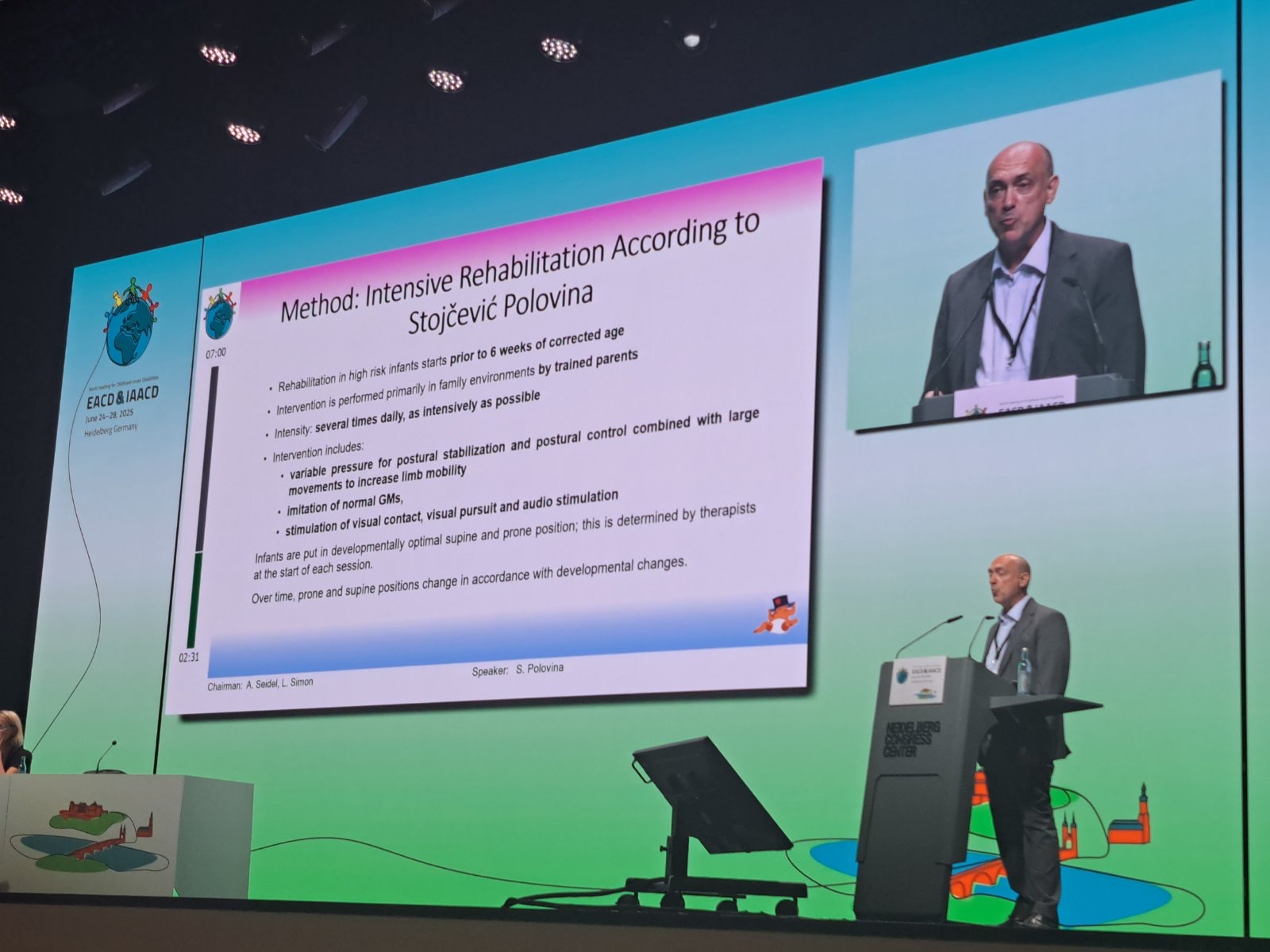
Preliminarni rezultati istraživanja Rane Intezivne Rehabilitacije prema Stojčević Polovina Metodi (Early Intensive Stojčević–Polovina Rehabilitation Method, EIR–SPM) prikazani su na 37. godišnjem skupu Europske akademije za razvojne poremećaje u djetinjstvu (European Academy of Childhood-onset Disability, EACD) i 4. trijenalnom skupu Međunarodnog saveza akademija za razvojne poremećaje u djetinjstvu (International Alliance of Academies of Childhood Disability, IAACD), održanom u Heidelbergu, Njemačka, od 24. do 28. lipnja 2025.
Predavanje:
Prospective study of the impact of early and intensive rehabilitation on changes in general movements in children: Preliminary results
Autori: Svetislav Polovina, Andrea Polovina, Romana Gjergja Juraški
Sažetak predavanja (Abstract)
Introduction: Prechtl’s assessment of general movements (GM) enables detection of high-neurorisk children at the earliest age. Pronounced abnormal writhing movements leads to higher risk of abnormal or absent fidgety movements (FM) which then significantly increases the risk of cerebral palsy. Early intensive rehabilitation according to the Stojčević Polovina method (IR-SPM) often results in the normalization of GM and the appearance of FM, reducing the risk of developing cerebral palsy.
Participants and Methods: Research group are high-neurorisk children with abnormal GM who started IR-SPM before the 6th week of corrected age. The control group are high-neurorisk children who are not included in IR-SPM. IR-SPM for high-neurorisk children under ideal conditions starts before 1.5 months of corrected age. The course of rehabilitation is determined by the child’s developmental and not chronological age. The rehabilitation is very intensive with the recommendation of several therapeutic cycles per day, performed in the family environment by the parents after the education.
Results: Preliminary results in the first 3 children included in the study showed that the abnormal GM at the time of writhing were followed by normal FM in all children.
Conclusion: Data collected so far must be interpreted with caution because the recruitment of the control group is still ongoing and it is not possible to prove statistical significance between the two groups. Despite this, given that the research group includes children with extremely high neurorisk, the preliminary results suggest that early intensive rehabilitation can have a favourable effect on the development of high-neurorisk children.
Objavljeno u: Developmental Medicine & Child Neurology, 2025 Jun; 67 Suppl 2:5-112. doi: 10.1111/dmcn.16355
Nastavak istraživanja objavljen je 2026. u časopisu Children (MDPI).
Pročitaj objavljeni rad (Open Access): https://doi.org/10.3390/children13050598

Svoje rehabilitacijske rezultate prikazale su i prof. Tamara Crnković, te Jelena Erceg i Ema Kovačić.

